
Door Hardware Functions Explained: Every Lock Type
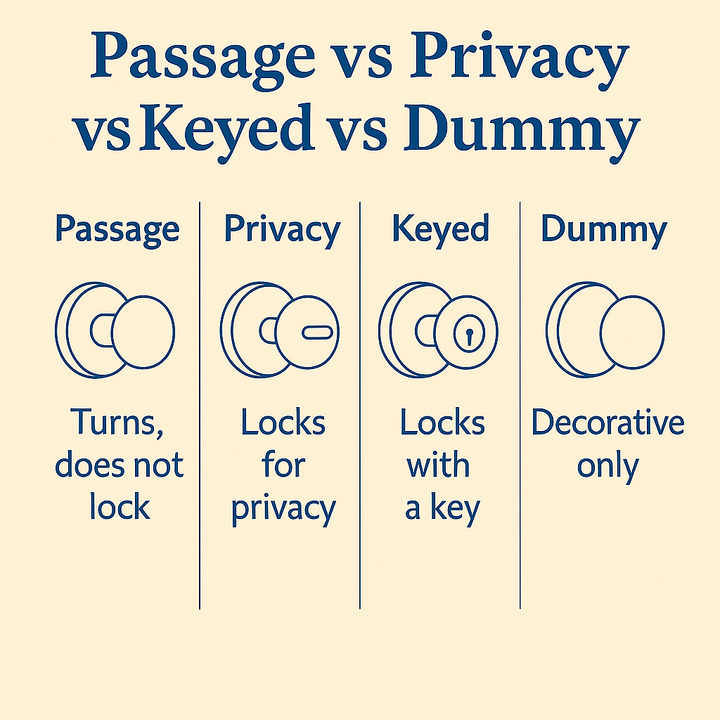
Wrong lockset on the wrong door is a fixable mistake only before installation. A passage set on a bathroom means no privacy. A privacy set on a front door means no real security. Each door in your home needs a specific function. Here is every one explained.
What Is a Door Hardware Function
The function of a lockset defines how it operates from each side of the door. Two locksets can look identical but one locks and one does not. Choose function first, finish second.
Passage Function
No locking mechanism at all. The latch operates freely from both sides at all times. Use it on hallways, interior pass-through doors, and closets that never need a lock. Do not use it on any door where privacy or security matters.
Privacy Function
Has a push button on the interior side that locks the outside lever when pressed. The inside always opens freely. A small pinhole on the exterior rosette accepts a thin pin for emergency release from outside.
Use it on bathrooms and bedrooms. Never on exterior doors since the emergency release opens with any pin in seconds.
Dummy Function
A fixed handle with no mechanical function. Does not turn, no latch, no lock. Surface mounted directly to the door face with no bore hole needed.
Single dummy: one side only, for closet or pantry doors using a magnetic or ball catch. Double dummy: both sides, for the fixed panel of French doors or decorative bifold doors.
Keyed Entry Function
Key cylinder on the exterior, thumb-turn on the interior. Key required to enter from outside. Interior always opens freely.
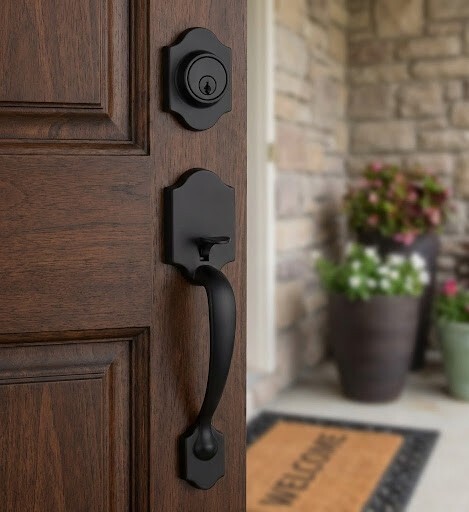
Use it on all exterior doors paired with a separate deadbolt. Also correct for any interior room needing key-controlled access. Door levers in keyed entry function are the practical choice for households with elderly occupants or young children since levers require no grip rotation.
Storeroom Function
Outside lever is always rigid. Key required every single time to enter from outside. Inside lever always free for exit.
Correct for supply rooms, utility closets, and storage areas that must stay locked at all times. The door cannot be left in an unlocked state.
Classroom Function
Outside lever operates freely by default. A key from outside locks or unlocks the outside lever only. Inside lever always free.
Correct for rooms that alternate between open access and secured states. A teacher or manager locks it with a key during a lockdown and unlocks it again with a key for normal access.
Storeroom vs Classroom: The Key Difference
Storeroom: outside lever always rigid, key needed every entry, cannot be left unlocked.
Classroom: outside lever free by default, key controls locked or unlocked state, inside always free.
Both keep the inside lever free for egress at all times. The only difference is whether the outside can be left unlocked.
Office and Entrance Function
Inside push-turn button locks or unlocks the outside lever. Staff controls access from inside without a key. When outside is locked, a key from outside opens the door once but the lever returns to locked after the door closes.
Correct for office reception areas and medical waiting rooms.
Room by Room Function Guide
Front door: keyed entry with separate deadbolt Back door or side entry: keyed entry with deadbolt Bathroom: privacy Bedroom: privacy Home office needing key access: keyed entry Hallway or interior pass-through door: passage Kitchen to living room or dining room: passage Closet needing a latch: passage Closet with magnetic or ball catch: single dummy Pantry door: single dummy or passage French door active panel: passage, privacy, or keyed entry French door fixed panel: double dummy Decorative bifold doors: double dummy Supply room or utility closet: storeroom Classroom or lockdown-capable room: classroom Office reception area: office and entrance function
Door Bore, Backset, and Cross Bore Measurements
Three measurements determine whether a lockset fits your door. Check all three before ordering replacement hardware.
Bore hole: large hole drilled through the door face, standard diameter is 2-1/8 inch. Older doors may have a 1-1/2 inch bore requiring an adapter.
Backset: distance from the door edge to the center of the bore hole. Standard interior doors use 2-3/8 inch. Exterior doors use 2-3/4 inch. Most modern locksets include an adjustable latch covering both sizes.
Edge bore: smaller hole on the door edge connecting to the main bore hole. Standard diameter is 1 inch.
Door thickness: most residential locksets fit 1-3/8 inch to 1-3/4 inch. Exterior and commercial grade doors up to 2 inch thickness need locksets rated for that range.
Knobs vs Levers
Both are available in every function. Knobs require grip and rotation which is difficult for people with arthritis or limited hand strength. Door knobs remain common in residential use but levers are the practical choice for ease of daily operation. ADA Standards require levers on all public-facing doors in commercial buildings.
For a consistent look across the home, choose a hardware collection where the same profile is available in passage, privacy, keyed entry, and dummy functions.
Common Mistakes
Passage set on a bathroom or bedroom: no privacy, cannot be locked, wrong function entirely.
Privacy set on an exterior door: not security hardware, emergency release opens with a pin, always pair exterior doors with keyed entry and a deadbolt.
Storeroom function when classroom is needed: storeroom cannot be left unlocked, classroom can, ordering the wrong one means replacing the hardware completely.
Not measuring backset before ordering: if existing bore is set for 2-3/8 inch and new lockset defaults to 2-3/4 inch, the latch will not align with the strike plate.
Frequently Asked Questions
What is a passage door knob?
A passage knob or lever operates the latch from both sides with no locking mechanism. Correct for hallways, interior doors, and closets that never need a lock.
What is a dummy set in door hardware?
A fixed handle with no mechanical function. No latch, no lock, surface mounted. Used on closet doors with a catch closure or on the fixed panel of French doors.
What is the difference between a storeroom lock and a classroom lock?
Storeroom keeps the outside lever permanently rigid and requires a key every entry. Classroom operates freely by default and a key from outside controls the locked or unlocked state. Both keep the inside free at all times.
What is a privacy lockset?
Interior push button locks the outside lever. Inside always opens freely. Emergency release on exterior opens with a pin. Use on bathrooms and bedrooms only, never on exterior doors.
What backset do I need?
Most interior doors use 2-3/8 inch. Most exterior doors use 2-3/4 inch. Measure from door edge to bore hole center before ordering.
What is a lockset?
Complete door hardware assembly including the knob or lever, latch mechanism, strike plate, and locking function. The function determines how and whether the door locks from each side.
At Inside Out Hardware we carry door knobs and door levers from Designers Impressions in passage, privacy, and keyed entry functions in satin nickel, matte black, oil rubbed bronze, and polished chrome. Free shipping on orders over $50 across the USA.
LATEST NEWS
How to Change a Door Knob: Complete Step by Step Guide
How to Change a Door Knob Changing a door knob is a 10-minute DIY project. You need a Phillips head...
Satin Nickel vs Brushed Nickel: What Is the Difference
Satin Nickel vs Brushed Nickel: What Is the Difference Brushed nickel has visible directional lines...
Best Hardware for White Cabinets: Finishes and Style Guide
Best Hardware for White Cabinets Matte black gives the boldest contrast on white cabinets. Brushed b...
Black Kitchen Hardware: Matte Black Pulls and Knobs Guide
Black Kitchen Hardware Matte black is the most popular kitchen hardware finish in the US market. It...

How to Choose the Right Door Hardware for Your Home
Door hardware comes down to four decisions: function, style, finish, and measurements. Get function...
How to Clean and Maintain Cabinet Hardware: Complete Care Guide
The right cleaning method depends on the finish. Using the wrong product causes permanent damage no...